IOWarp
The NSF-funded context-management program I proposed and architect across GRC, The HDF Group, and the University of Utah. IOWarp connects the HPC, storage, I/O, and data-systems lineage to scientific AI through the CLIO architecture.
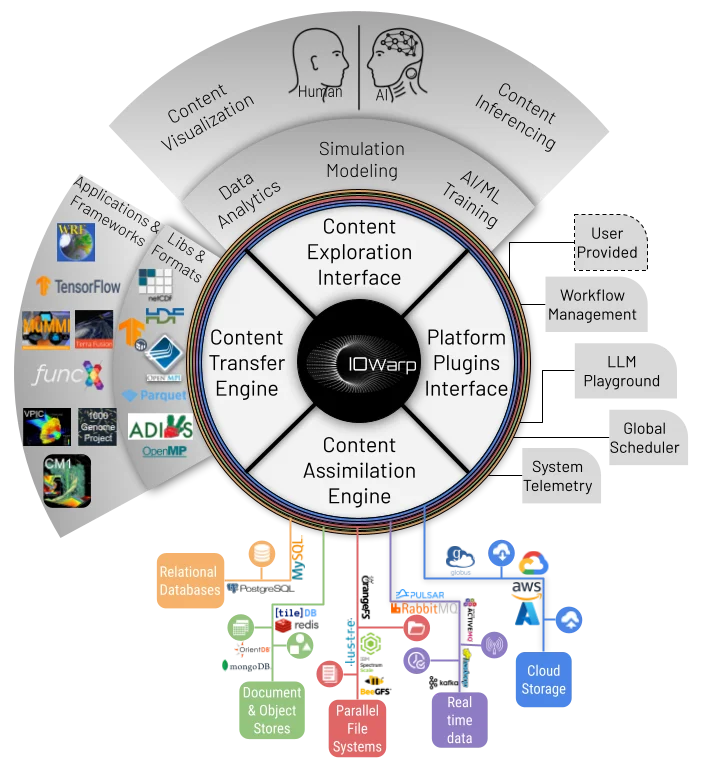
IOWarp and CLIO, the systems that led to them, the tools I build myself, and the research environment around them, from 2017 to now.
The NSF-funded context-management program I proposed and architect across GRC, The HDF Group, and the University of Utah. IOWarp connects the HPC, storage, I/O, and data-systems lineage to scientific AI through the CLIO architecture.
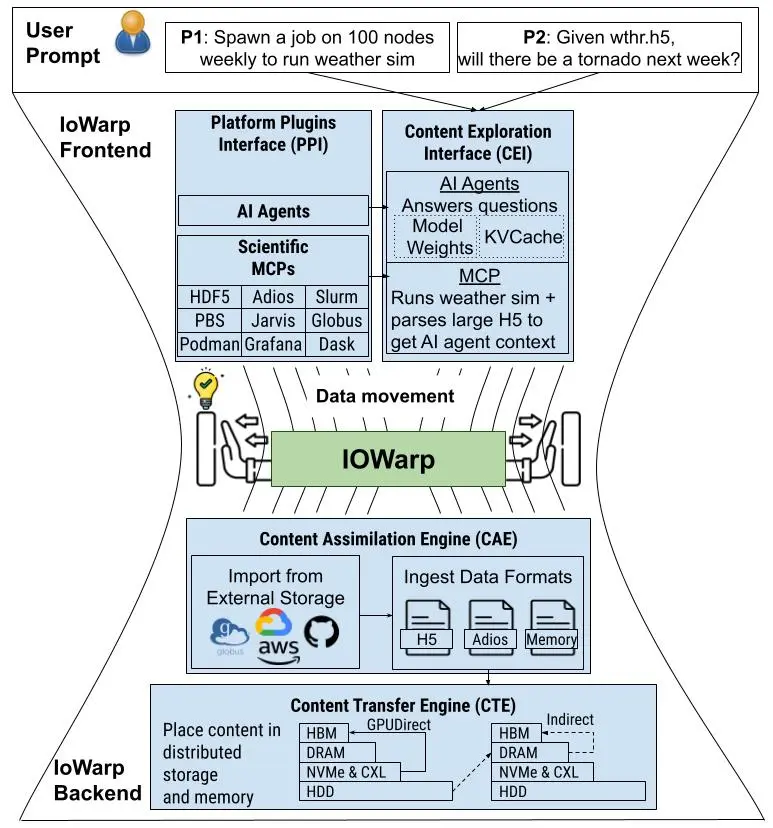
Context Layer for Input/Output, the architecture I created for IOWarp. Its shared contracts let Core, Kit, Agent, Relay, and Coder give scientific AI agents structured, queryable context, with each component built by its own team.
ICS'18. Files and objects behind one interface.
HPDC'18, then NSF 2018–2023. Multi-tier I/O buffering.
HPDC'19 best paper, US patent 2023, NSF 2023–2027.
MSST'20, then NSF 2021–2027. A time-ordered shared log.
Argonne, PNNL, and Livermore subcontracts from 2022. I/O meets AI.
DOE 2023–2026, SSDBM'25. Labels become data tasks.
NSF 2024–2029. The platform under CLIO.
Core, Kit, Agent, Relay, Coder. The context layer.
The natural-language interface I wrote into the IOWarp proposal.
Scientific personas and context handover inside an agent, first as extensions for Claude Code and Gemini CLI, then as Warpio CLI.
AWOC
The fleet model. Coding agents as bounded workers to direct with typed intent, rather than a library to call.
The runtime. A control loop, a scored worker pool, and a reproducibility receipt for every run.
The research line brought together under IOWarp: typed tools, bounded workers, sealed receipts, and local models.
The multi-tier I/O buffering system I created during my PhD, carried through five years of NSF funding into versioned middleware released under The HDF Group, and forward into IOWarp.
Label-based I/O from my dissertation: a request carries its intent, so the storage system can schedule and transform it. The HPDC 2019 paper won the Karsten Schwan Best Paper Award and the representation became US Patent 11,630,834.
A distributed shared log that orders activity data by physical time instead of consensus. My MSST 2020 design, funded by NSF for six years, and now at version 3 with SQL, pub/sub, and an MCP server.
A task-based I/O runtime built with Argonne under a DOE ASCR award. Labels became composable data tasks, online format translation with caching beat offline conversion by 49.6%, and the mechanisms were reimplemented inside CLIO Core.
A line of subcontracts with Argonne, Pacific Northwest, and Lawrence Livermore that funds students working where I/O meets AI, from Viper and KV-cache scheduling for LLM inference to WisIO's I/O bottleneck analysis.
The coding agent I create and maintain inside CLIO, for the people who maintain the code science runs on. It runs against a local or remote model of your choice, coordinates bounded work through typed tools and managed coding peers, and records results for inspection.
KeepIndex is a search application whose app, index, and search-engine container all run on the machine in front of you, with answers generated by a local runtime or an endpoint you select. It indexes the folders, Obsidian vaults, documents, and browser profiles you grant it, answers alongside public web results, and shows the passages behind every citation.
A staged research-writing workflow a coding agent can run: a specification, an outline, section plans, bounded drafts, and review against the evidence. Released publicly as an npm package and a tagged GitHub release.
An MCP server that connects an agent to Zulip streams, topics, and people. It is released on PyPI with a focused core tool set and an extended mode for less frequent operations.
The Gnosis Research Center, co-founded with Xian-He Sun in 2023 and now home to research faculty, engineers, and a dozen PhD students.