Work / active / 2020–present
DeepIO
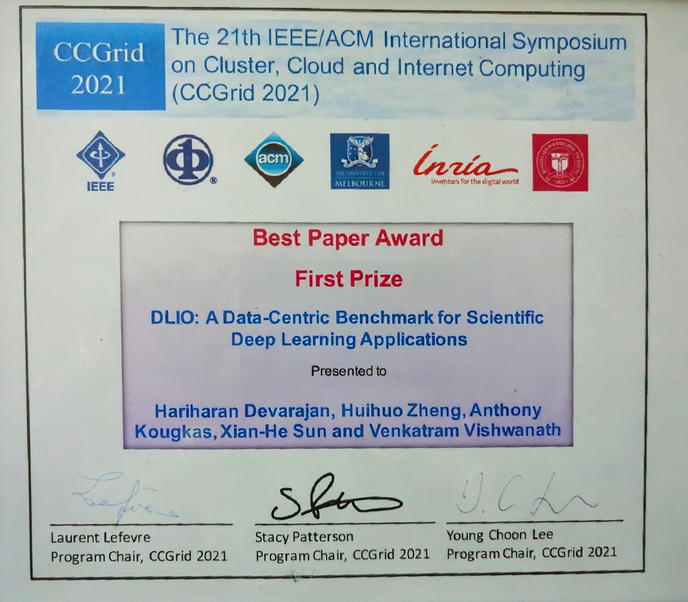
I/O for scientific AI, measured before optimized. DLIO, the benchmark my team built with Argonne, won a best-paper award and became the workload generator inside MLPerf Storage. The line continues through Viper, WisIO, and KV-cache scheduling for LLM inference.
With Hariharan Devarajan, Huihuo Zheng, Venkatram Vishwanath, Jie Ye, Bogdan Nicolae, Izzet Yildirim and 7 more
The question
Around 2020 every AI-for-science conversation ended at the same place: the GPUs were waiting for data, and nobody could say precisely why, because there was no representative way to reproduce the I/O of a scientific deep-learning job. Each team measured its own pipeline its own way and the numbers did not compare.
DeepIO started with the discipline I wanted the field to adopt: measure first, with a benchmark people can argue about, then optimize.
DLIO, and what it became
Hariharan Devarajan and I built DLIO with Huihuo Zheng and Venkatram Vishwanath at the Argonne Leadership Computing Facility, profiling real cosmology, particle-physics, and climate workloads on Theta and turning them into a configurable emulator. The CCGrid 2021 paper won the Best Paper Award, and the optimizations it guided reduced training time by up to 6.7x on the workloads we studied.
Then something happened that I did not plan. MLCommons needed a workload generator for a storage benchmark, and MLPerf Storage was built on DLIO. The README of the suite still points at dlio_benchmark as the engine that emulates each workload. A research tool from a university lab became the yardstick that storage vendors use to make claims about AI. I wrote about that moment in the Journal. The benchmark is maintained today at argonne-lcf/dlio_benchmark, with v2.0.1 as the current release.
The line after the benchmark
DeepIO became the umbrella for the data path of scientific AI, funded through Argonne subcontracts on which I am the PI, with Xian-He Sun as co-PI and Bogdan Nicolae as the Argonne partner.
Stimulus connected scientific formats to AI frameworks and sped up ingestion by up to 5.3x on Summit. TunIO, Neeraj Rajesh’s IPDPS 2024 work, searched layered I/O configurations automatically. Jie Ye then moved the question to inference. Viper at ICPP 2024 schedules and transfers model updates between concurrent training and inference through memory, cutting model-update latency by roughly 9x. UnboxKV at IPDPS 2025 characterized how KV caches behave under concurrent transformer inference, and PKAS at HPDC 2026 used predicted cache demand to schedule requests, up to 7.34x more throughput than the schedulers it was compared against.
Measuring before optimizing
The other half of DeepIO is I/O characterization, funded through Lawrence Livermore subcontracts with Kathryn Mohror as the partner. DFTracer, Hariharan’s SC 2024 tracer, captures AI workflow activity at 1 to 5% overhead. WisIO, Izzet Yildirim’s ICS 2025 system, analyzes multi-terabyte traces through time, process, and file views and explains bottlenecks rather than only counting them: up to 805x more bottleneck coverage than a single view, and up to 11x faster analysis than the tools it was compared against. WisIO v0.2.0 shipped publicly in July 2026. IntentIO, the 2026 follow-on with Nikoli Dryden, extracts I/O intent from training runs with machine learning.
Why it matters for the agents
Everything I now do with Clio Coder inherits this posture. A coding agent that claims to be better needs a benchmark someone else can run, which is why the SWE-bench, SciCode, and Terminal-Bench harnesses ship in the repository and why I want a public behavioral regression corpus. And a 20B model on one GPU is an inference-serving problem before it is anything else; Jie’s KV-cache work is the reason I care about prefix-cache stability in the harness.
Where it stands
DeepIO is active. The 2026 Argonne renewal and the Livermore IntentIO award run this year, Isa Muradli and Jie are studying GPU-attached storage and dynamic tensor routing for multi-GPU inference, and the benchmark keeps being maintained by the community around ALCF. I am the PI on the awards; the results belong to the people whose names are on the papers.
People
- Hariharan DevarajanFirst author of DLIO; DFTracer
- Huihuo ZhengDLIO co-author, Argonne Leadership Computing Facility
- Venkatram VishwanathDLIO co-author, Argonne Leadership Computing Facility
- Jie YeViper, UnboxKV, and PKAS
- Bogdan NicolaePartner, Argonne; KV-cache work
- Izzet YildirimWisIO and IOMax
- Kathryn MohrorPartner, Lawrence Livermore; WisIO
- Xian-He SunCo-PI
- Jaime CernudaResearcher
- Neeraj RajeshTunIO
- Keith BatemanResearcher
- Isa MuradliResearcher
- Nikoli DrydenPartner, Lawrence Livermore; IntentIO
Institutions

Topics
- systems
- data
- scientific computing
- agents
- building
Artifact trail
Inspect the work
Each link has a job: code shows implementation, releases mark runnable boundaries, and papers record the argument and evaluation.
- paper
DLIO at CCGrid 2021
The data-centric benchmark for scientific deep learning I/O. Best Paper Award.
- code
argonne-lcf/dlio_benchmark
The benchmark, maintained at the Argonne Leadership Computing Facility with the community. v2.0.1 is current.
- code
mlcommons/storage
The MLPerf Storage benchmark suite. Its README documents that the simulation runs through dlio_benchmark.
- paper
Viper at ICPP 2024
Jie Ye's framework for moving model updates between concurrent training and inference through memory.
- paper
UnboxKV at IPDPS 2025
Characterizing KV-cache behavior under concurrent transformer inference, with Bogdan Nicolae.
- paper
WisIO at ICS 2025
Izzet Yildirim's multi-perspective I/O bottleneck analysis, built with Lawrence Livermore.
- paper
DFTracer at SC 2024
The analysis-friendly tracer for AI-driven workflows that feeds WisIO.