Work / evolving
LABIOS
What happens when an I/O request carries its own intent. A paper, a patent, and now a public experimental runtime.
- Period
- 2017–present
- My role
- Co-PI and co-inventor
- Evidence
- verified
- Updated
The question
Most I/O interfaces discard intent. They receive an address, a size, and an operation, then force the rest of the system to infer why the data matters and what should happen next.
LABIOS started with a different question: what if an I/O request carried its meaning with it? A label can bind an operation, a data reference, and routing metadata into something the system can inspect, schedule, and transform.
The architectural bet
The label is deliberately small. It is not a new file format and it is not a claim that metadata solves every storage problem. It is an executable contract between an application and a data service.
That changes the shape of the runtime. Work can be decoupled from the application’s critical path. Different workers can handle storage, transformation, or movement. Policies can make decisions from explicit intent instead of reverse-engineering a stream of anonymous reads and writes.
From result to software
The first system established the idea and its performance boundary in peer-reviewed work. The patent preserves the core representation. The current public prototype is the more interesting test: can the abstraction survive new workloads, clearer APIs, agent-facing tools, and the ordinary friction of open software?
The labios-2.0 branch calls itself 2.1.0-rc.1, for development and evaluation. Its reference deployment is single-host Docker Compose. It is not a production release. Nobody has shown it running multi-node yet, the Tier-2 reasoning layer is not there, and I am not going to claim a performance win the current code has not earned. The agent-oriented pieces are experimental or planned. I would rather say that plainly than let a diagram do the promising.
My part, and the people who made it real
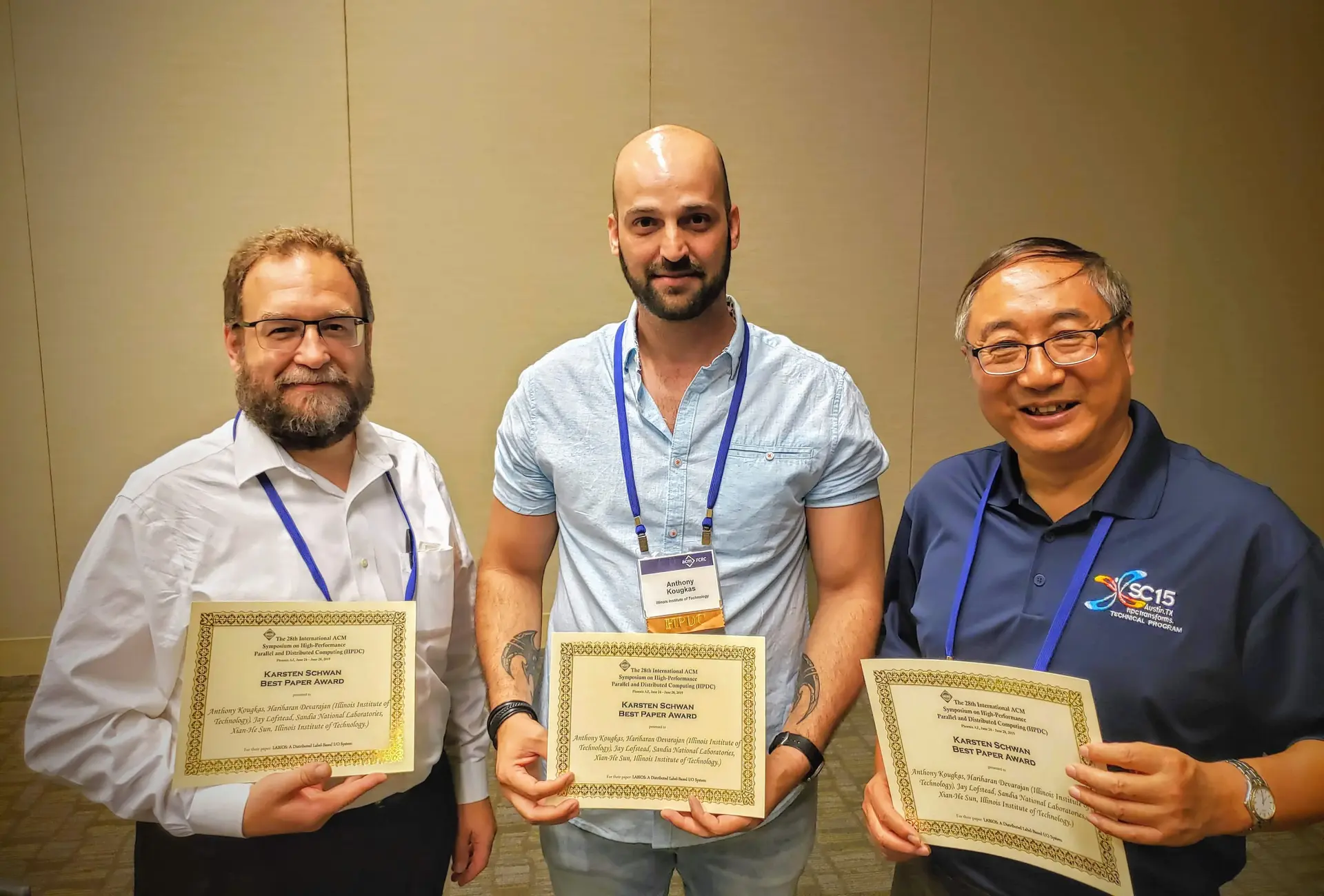
I helped originate the label-based approach and have carried its architecture across the paper, patent, funded follow-on work, and implementation. That continuity does not make it a solo project. LABIOS grew through close collaboration with Xian-He Sun, Jay Lofstead, Hariharan Devarajan, students, and laboratory partners. The strongest version of the story names those contributions rather than compressing them into “led.”
What changed in my thinking
I used to describe labels mainly as an I/O optimization. I now see them as a way to preserve intent across a system boundary. That makes the idea relevant to agents, pipelines, and provenance, but only if the interface stays precise enough to test.
The next question is not how many capabilities can fit behind a label. It is how few semantics are needed to make useful composition possible without turning the label into another opaque application protocol.
Collaborators
- Gnosis Research Center
- Sandia National Laboratories
- Lawrence Livermore National Laboratory
Topics
- systems
- data
- scientific computing
- building
Artifact trail
Inspect the work
Each link has a job: code shows implementation, releases mark runnable boundaries, and papers record the argument and evaluation.
- code
LABIOS 2.0 release-candidate branch
The 2.1.0-rc.1 development branch. Single-host Docker Compose is the reference deployment.
- paper
LABIOS paper
The original label-based I/O design and evaluation.
- patent
Label-based data representation patent
The durable record of the underlying representation and process.