KeepIndex
A private search application that runs on one computer.
KeepIndex is a search application whose app, index, and search-engine container all run on the machine in front of you, with answers generated by a local runtime or an endpoint you select. It indexes the folders, Obsidian vaults, documents, and browser profiles you grant it, answers alongside public web results, and shows the passages behind every citation.
The question
Search over a personal corpus usually begins by handing the corpus to someone else. Notes, documents, and browser history go into a hosted index, and the answer that comes back cannot be traced to the passage that produced it.
KeepIndex starts from the opposite constraint. Can one computer index the folders its owner selects, search them beside the public web, and show the exact lines behind every sentence of a generated answer, without an account, a hosted index, or a cloud fallback?
Where it came from
KeepIndex answers a question I first took up in an earlier repository, evresis. The current implementation starts from a first commit on 2026-08-29 and shares no code with it.
The bet
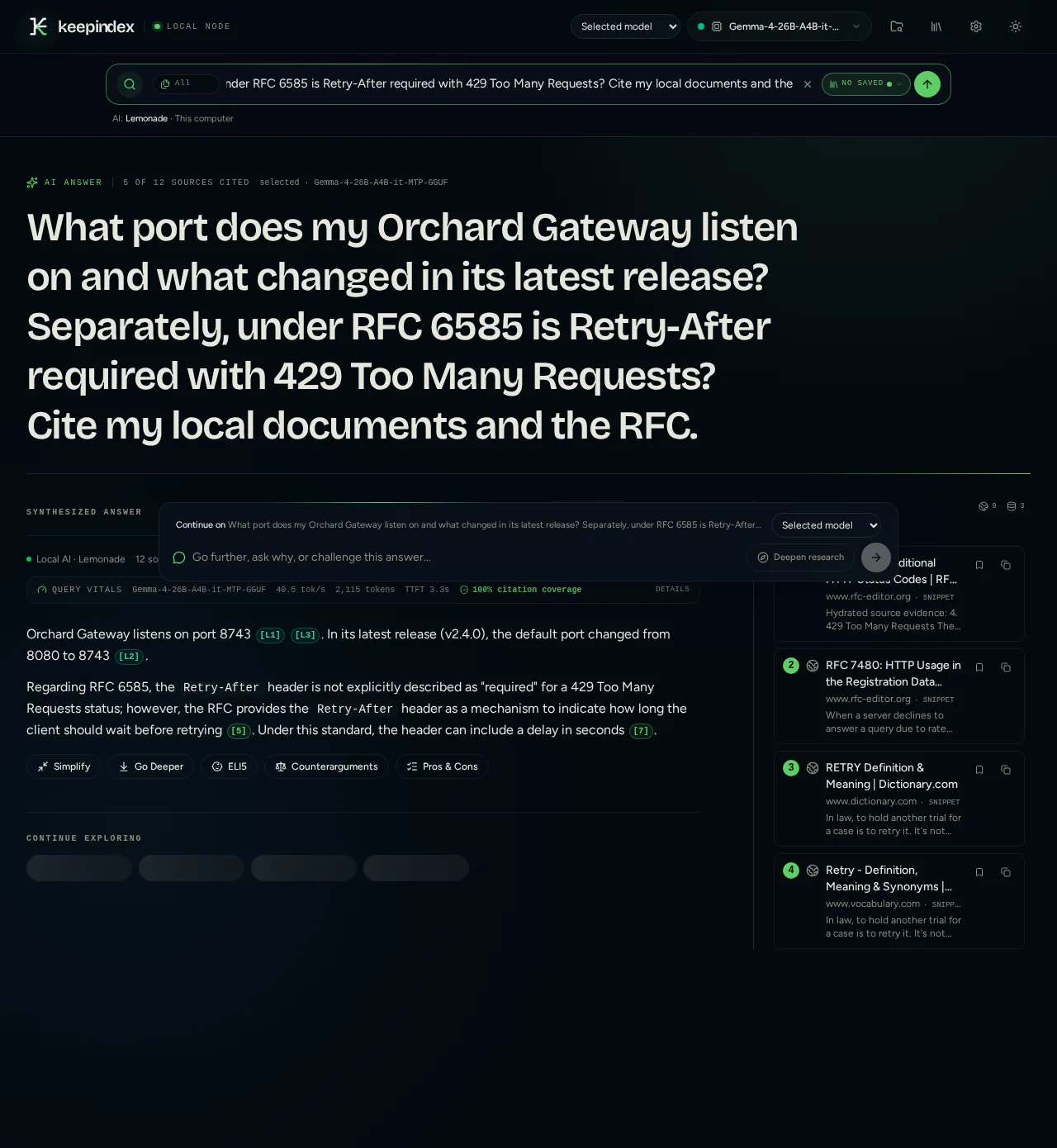
The bet is that privacy is a deployment property rather than a policy sentence. The application, the SQLite index, and the SearXNG container run locally, both published ports are fixed to loopback, and the API rejects remote host names and foreign browser origins. Nothing reaches the network until a query targets a web provider or a prompt goes to the inference endpoint the user selected.
The second bet is that model choice belongs to the user. Lemonade, LM Studio, Ollama, llama.cpp, and other compatible endpoints are all selectable, there is no automatic fallback between connections, and the active endpoint is displayed beside the query box. Selecting a remote endpoint sends prompts and retrieved excerpts to it; the files and the index stay where they are.
What shipped
v1.0.0 published on 2026-08-29 with a one-command Compose start, an installable local web app, federated ranking over selected sources, and post-generation grounding gates. v1.1.0 followed on 2026-09-10 with retrieval hardening: evidence admission by absolute score and query coverage, citation repair gated on lexical support, and metadata-only stubs excluded from citable evidence. The current line adds Collections, a search-provider registry with typed budgets and circuit breaking, a retention policy over four record classes, and a persistent SQLite FTS5 index.
The index rewrite is the change with numbers behind it. On an HP ZBook under WSL2 with 24 cores and 31 GiB of RAM, indexing a synthetic corpus of 8,000 Markdown files capped at 160,000 chunks, peak resident memory during indexing fell from 6,106 MiB to 135 MiB on an idle host, while full index duration rose from 38.4 s to 63.3 s.
A separate screen on 2026-09-11 compared local models through Lemonade 11.9.0 on an AMD Ryzen AI MAX+ PRO 395 with 128 GB of RAM. It records 357 trials across 11 model files and 14 configurations against a frozen synthetic corpus. Gemma 4 26B A4B with MTP scored 14 of 16 strict answer passes and 8 of 8 selection passes at a 1.60-second median answer latency, and stays the default on that machine. Gemma E2B QAT reached 13 of 16 answer passes at a 0.66-second median. No tested model passed the repetitive long-pack case, and the report states that this suite does not establish accuracy on arbitrary questions.
The boundaries
KeepIndex works, and it is not yet my daily search.
Other boundaries are recorded rather than solved. The WSL2 ZBook is the only environment the v1.2 evaluation suite exercised. The Brave adapter has not been run against a live subscription. The local API has no user authentication, so loopback and origin checks are the boundary for a personal installation and not isolation from other users of the same machine. Federation, pairing, and remote access are deferred.
What carries forward
The discipline that matters here is evidence admission: deciding what a model is allowed to see, and refusing an answer whose claims are not supported by the passages cited. That is the same problem CLIO Coder solves on the other side of the desk, where the question is what a coding agent is allowed to run. The benchmark’s live smoke checks used CLIO Coder’s own release history as a query, and the failure they exposed, an invented publication timestamp passing a citation check, was worth more than the passes.
Code, releases, papers, and records
- code
KeepIndex repository
The application, the CLI, the Docker Compose stack, the benchmark harness, and the public development history.
- release
KeepIndex v1.0.0
The first public release, published 2026-08-29, with the one-command Compose start and the local-inference policy.
- evidence
Measured model matrix, 2026-09-11
Strict answer outcomes, document selection, and latency for each tested model file and configuration, with the corpus, prompt, and scorer hashes.