Last year I wrote that if I had to sum up 2024 in one word it would be transformation. I am not going to pick a word for 2025. It was a year where most of what I care about happened on schedule, which is its own kind of news, and where the arguments I have been making about scientific computing stopped being predictions and started being descriptions. I find that more satisfying than I expected, and a little unnerving.
The work
In June, Illinois Tech promoted me to Associate Research Professor. I have been at this university since 2013, as a student, a research assistant, an assistant research professor, and now this. The title is less interesting to me than what it acknowledges: that the center Xian-He Sun and I started in 2023 is a real institution with real output, and that the systems line running from Hermes to IOWarp is one program rather than a series of grants.
I came to this university in 2013 with a military career behind me and no plan beyond finishing a degree. I did not plan the program either. It turns out you can build one anyway if you keep pulling the same thread.
I spent the year saying one thing in different rooms. The argument did not change between rooms. The questions did, and the questions are what I keep.
- July 20. The keynote at the AI4Sys workshop at HPDC in Notre Dame, on data management challenges in the age of agentic AI.
- September 30. A seminar at Argonne on the same question, framed as the move from storage optimization to context.
- October 24. A lunch talk at the Innovative Computing Laboratory at Tennessee about AI coding tools for HPC researchers, with live demonstrations on real codebases.
- November. A guest lecture at Ohio State on data management in the AI era.
The center’s papers this year are in the archive: five conference papers and three posters. I am a co-author on those, and the first authors did the work.
- IPDPS. Jie Ye characterized KV caching under concurrent inference.
- ICS. Izzet Yildirim presented WisIO, multi-perspective I/O bottleneck detection.
- SSDBM. Keith Bateman presented DTIO, at the conference where I also served as General Vice Chair in June.
- PDSW. Meng Tang put S3 on a roofline.
- REX-IO. The Rabbit storage work with Livermore collaborators.
- eScience posters. Shazzadul Islam and Isa Muradli measured what agents and GPU-direct transfers are actually worth on scientific data.
The software moved too. IOWarp delivered its first integrated beta in September, and by year’s end CLIO had component leads, release cadences, and a name.
Service was heavier than any year before it: General Vice Chair for SSDBM in June, Program Co-Chair for PDSW at SC25 in November. I wrote about the second one last month. I learned more about how a community runs from one program committee meeting than from a decade of attending. I also learned that I like the work, which I did not expect to write down.
Two dissertations
The two events that mattered most to me happened in September and December. Luke Logan defended in September. He joined the lab as an undergraduate in 2017, built the runtime underneath Hermes, wrote LabStor and MegaMmap, and became the person I ask about persistent memory. Jaime Cernuda defended on December 15. HFlow, Hades, HStream, Jarvis: a line of work on how data moves through a pipeline, and the reason IOWarp deploys reproducibly at all.
I have been part of PhD committees before. This was the first time two people whose doctoral work happened inside systems I helped architect finished in the same semester. I do not have a tidy lesson about it. I have the feeling of watching two people become better at their subject than I am, which is the point.
Both of them now correct me in meetings, and I would rather be argued with by people I trained than agreed with by anyone else. That is the whole of what I want to say to them here.
Teaching
Over the summer I ran a weekly AI-assisted programming seminar for the group’s graduate researchers. The premise was that using a coding agent well is a skill with structure, not a trick, and that a research group should learn it together and argue about it in the open. We compared tools on the same task, we wrote prompts as if they were programs, and we built a checklist for what an autonomous agent needs before anyone should trust it. I will write that up properly. What I want to record here is that teaching it changed how I use the tools myself, which is the usual direction. Every teacher I have respected said this, and I had to run the seminar to believe it.
The moment I keep is small. One student’s prompt template, written as a function with named inputs and a declared output, was in everyone else’s repository within a week. Nobody assigned that. It was adopted because it worked, which is the only kind of standard a research group ever really follows.
The hard parts
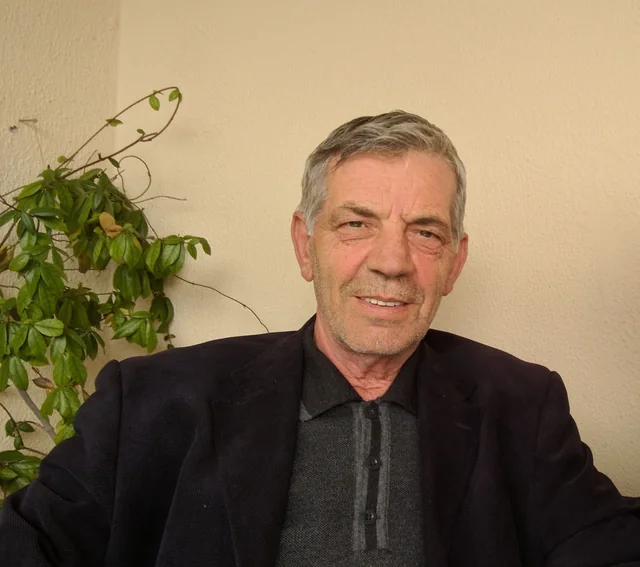
My father, Sotiris, died in December. It was cancer, and the last few months were rough on him. I was in Chicago for most of them, overwhelmed by a year that did not slow down for anything, and my immigration status kept me in the United States when I wanted to be in Greece. I am not going to draw a lesson from it, and I do not want it to take anything away from the year above. His name means savior in Greek.
What I learned
I have been making one argument in talks all fall and wrote it down this month for the center’s site. The scarcest resource in research is no longer deep knowledge of one task. It is the ability to orchestrate compute, data, capital, and expert judgment into a loop that produces a result. That is not an argument for less expertise. It is an argument that expertise now pays off most when it is embedded in a system that agents and people run together, and that the researcher’s job is increasingly to design that loop and to know which steps require a human. I believe it more at the end of the year than I did at the beginning, mostly because I watched students in our seminar do it.
The second thing is smaller. Dates matter. Half of what I did this year was keep a calendar honest: a call for papers, a review deadline, a defense, a release. A research program is an argument with a schedule attached, and the schedule is where it either becomes real or does not. I ran on schedules for a decade before I ran a lab. I am only now admitting how much of that carried over.
What I am proud of this year is not on any CV. The group reviews each other’s work in the open now: prompts, code, drafts, and the arguments about them. In June people used these tools quietly and alone. By December they were correcting each other’s prompts where everyone could see. I did not build that directly. I built the room and stayed in it.
What 2026 is for
The program is funded, the architecture has a name, the team has two new doctors in it, and the tools we are building are starting to be used by people who did not build them. Next year is for making the receipts real: every action an agent takes on scientific data, accounted for in a way another person can inspect. It is also for writing more, here, where the ideas can be argued with. I have said that before. The difference this year is that I have started.
To the people who were part of this year, in the lab and outside it: thank you. You know who you are.
For Sotiris.